
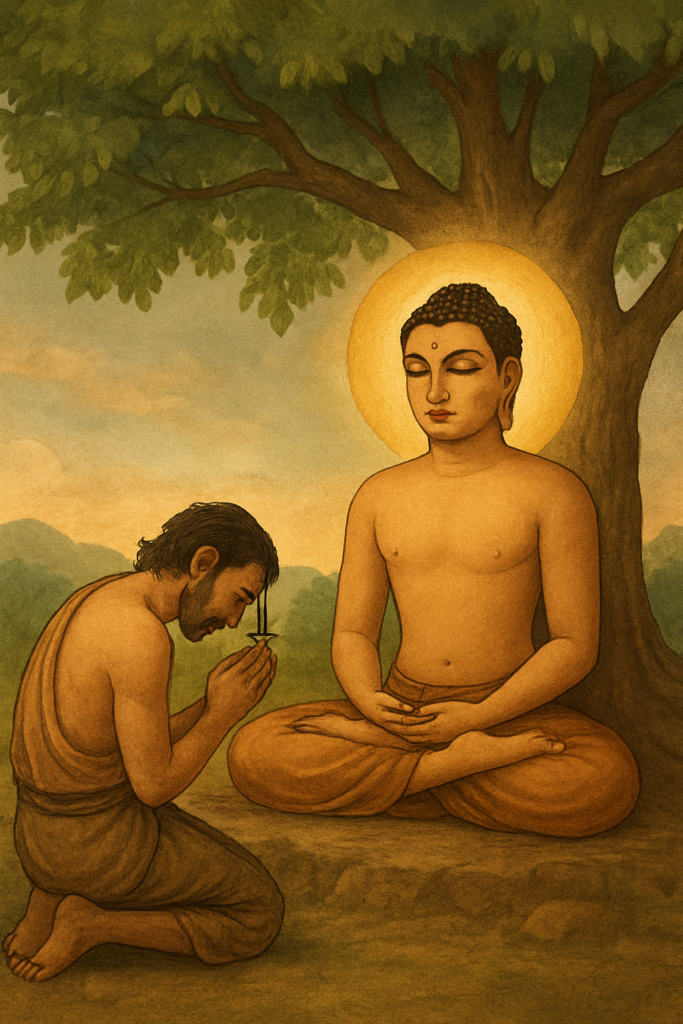
On the third day of Paryushan Parva, we observe Chaudas. This day is marked with deep spiritual practices, reflection, and forgiveness. The Pratikraman of Chaudas is more elaborate than daily Pratikraman, with extended Kausag (meditation in silence) and longer sutras—allowing us to cleanse our thoughts and actions at a deeper level.
But Day 3 holds one more special significance—it marks the beginning of the Vanchan (recitation) of Kalpasutra, one of the most sacred Jain texts.
The Essence of Forgiveness
Forgiveness is the highest strength of the soul. It is not about weakness—it is about freeing ourselves from anger, grudges, and hatred. When we forgive, we release karmic bondage and walk closer to liberation.
“When we forgive, we stop the cycle of karma from spinning further.”
On Chaudas, we reflect on the power of forgiveness, reminding ourselves that to forgive is to rise above ego and pain.
“Forgiveness is the mirror where our soul sees its true strength.”
Lord Mahavir’s Example of Endurance
A powerful incident from Lord Mahavir Swami’s life teaches us this virtue.
While in deep meditation (tapasya), a cruel act was committed—nails were hammered into his ears. Yet, Bhagwan Mahavir remained undisturbed, calm, and forgiving. He did not curse his tormentor, nor did he express hatred. His silence and compassion demonstrated that true forgiveness is unshakable, even in suffering.
“Patience is not the ability to wait—it is the strength to remain calm while in pain.”
“Silence in anger is greater than a thousand words of revenge.”
This story reminds us: Forgiveness is not only an act—it is a state of the soul.
The Beginning of Kalpasutra Vanchan
From Day 3 of Paryushan, the Kalpasutra, a sacred Jain scripture, is recited in Jain temples.
What is Kalpasutra?
The Kalpasutra is a holy text composed by Acharya Bhadrabahu Swami. It is one of the most revered Jain scriptures, read with devotion during Paryushan.
It contains three main sections:
- Life of Lord Mahavir Swami – including his birth, renunciation, enlightenment, and nirvana.
- Lives of Earlier Tirthankaras – particularly Lord Parshvanath and others.
- Rules for Monks & Nuns – emphasizing discipline, austerity, and spiritual conduct.
“Scriptures are not stories of the past—they are mirrors of how we must live in the present.”
Importance of Kalpasutra
- It reminds us of the sacrifices, compassion, and teachings of Lord Mahavir.
- It strengthens our faith by reconnecting us with the core values of Jainism.
- The Paryushan atmosphere becomes more sacred as devotees listen to these timeless teachings with devotion.
The beginning of Kalpasutra Vanchan on Chaudas symbolizes spiritual awakening, just as Lord Mahavir illuminated the path of liberation with his wisdom.
“Knowledge purifies the mind, patience purifies the body, forgiveness purifies the soul.”
Reflection for Us Today
- Am I practicing forgiveness like Lord Mahavir taught?
- Can I let go of grudges to lighten my soul?
- Do I listen to the Kalpasutra with full devotion and mindfulness?
“Karma binds, but forgiveness frees.”
Closing Thought
On Day 3, let us embrace forgiveness and the wisdom of Kalpasutra.
Forgiveness purifies the soul, and scriptures illuminate the path. Together, they lead us towards liberation.
“Paryushan is not just a festival—it is a journey from outside noise to inner peace.”